


Most people believe financial progress comes from earning more money.
But after years of working with executives, business owners, and high income families, we have found something different:
Most people do not have an income problem. They have a cash flow design problem.
Raises happen.
Bonuses increase.
Lifestyle expands.
Yet many people still feel behind.
Not because they failed.
Because the system they are running quietly pushes income toward spending before wealth building ever happens.
Direction must precede optimization.
And when cash flow is aligned intentionally, wealth compounds differently.
What Determines Whether Higher Income Creates Wealth?
The difference is usually not income level. It is cash flow design.
1. Default Systems Create Lifestyle Expansion
Income flows directly into spending and saving happens only if money is left over.
2. Intentional Systems Capture Wealth First
Money is intentionally directed toward future goals before lifestyle absorbs increases.
3. Small Changes Compound Dramatically
Even small increases in savings rates create outsized long term outcomes.
4. Structure Reduces Reliance on Willpower
Good systems remove decision fatigue and create automatic progress.
1. The Default Cash Flow System Most People Run
Most households unknowingly operate like this:
Income → Checking → Lifestyle → Save What Is Left
Typical Cash Flow System
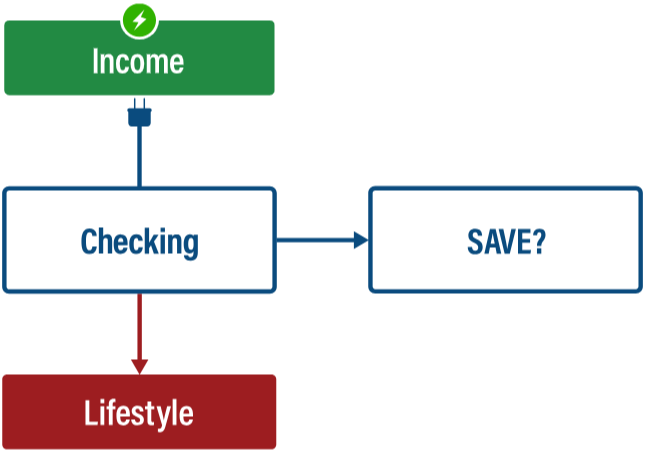
At first glance, this seems reasonable.
Income arrives.
Bills get paid.
Life happens.
Maybe some money goes to savings.
The challenge is subtle:
Lifestyle becomes automatic.
Saving becomes optional.
When income rises, spending often rises too.
This is why people making significantly more money than they did ten years ago sometimes still feel financially stuck.
Misalignment compounds quietly.
2. Why Higher Income Alone Does Not Solve the Problem
We often ask clients:
“What were you making ten years ago?”
Most laugh.
Because the answer is usually:
“Half of what I make today.”
Then we ask:
“Did your lifestyle increase too?”
More laughter.
The final question is where things get interesting:
“Did wealth grow at the same pace?”
That is often where people pause.
Because higher income does not automatically create higher savings rates.
It frequently creates higher lifestyles.
Without structure, excess income simply becomes easier spending.
3. Small Changes Create Massive Differences
Let’s look at a simplified example.
Imagine a household earning $200,000 annually.
They save 10% consistently.
Over time they build approximately $2.6 million.
Now change only one thing:
Instead of allowing lifestyle to absorb everything, they capture 1% more each year.
Not 10%.
Not aggressive budgeting.
Just 1%.
The result?
Their long term wealth exceeds $5 million.
The surprising part:
Most people would never notice that difference month to month.
Small alignment decisions create large outcomes.
Alignment compounds.
4. The Wealth Building System
Instead of letting money flow directly toward spending, we flip the sequence.
Wealth Building Account Framework
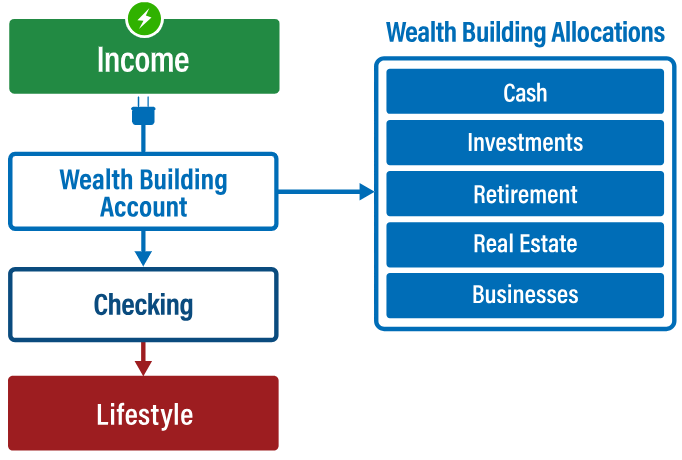
The flow becomes:
Income → Wealth Building Account → Checking → Lifestyle
The difference is powerful.
Income enters the wealth building account first.
From there money can be intentionally allocated toward:
Cash
Investments
Retirement
Real Estate
Businesses
Lifestyle is funded intentionally from what is distributed afterward.
This changes everything.
Savings become automatic.
Lifestyle becomes designed.
Wealth building becomes a system instead of a decision.
5. Why Structure Beats Willpower
Traditional advice often sounds like:
Budget harder.
Track everything.
Cut expenses.
Optimize more.
But most people do not fail because they lack effort.
They fail because they rely on willpower.
Willpower fades.
Structure scales.
When the system works correctly:
You stop obsessing over every transaction.
You gain clarity.
You build flexibility.
And wealth grows without feeling restricted.
That is the goal.
Life first.
Wealth second.
Because money is the tool, not the destination.
Reflection Section
Take a few minutes and think through these questions:
- Has my lifestyle increased at the same pace as my income?
- If income rose next year, where would that money go?
- Am I relying on discipline or structure?
- Does my current system intentionally build wealth?
- What would change if savings happened automatically?
Next Steps
Subscribe to the Built For Life, Not Just Wealth podcast where we unpack these concepts and show how thoughtful design changes long term outcomes.
Complete the Financial Scorecard to understand where your current structure stands across cash flow, flexibility, and wealth building alignment.
Book a meeting with Ryan or a member of the QFP team if you want to explore whether your current system supports the life you are trying to build.
Because when life and money move together, progress becomes sustainable.
And alignment compounds.